Early February 1 February
42°F
Typical afternoon high
36% historical wet-day frequency
Austria · Countryside
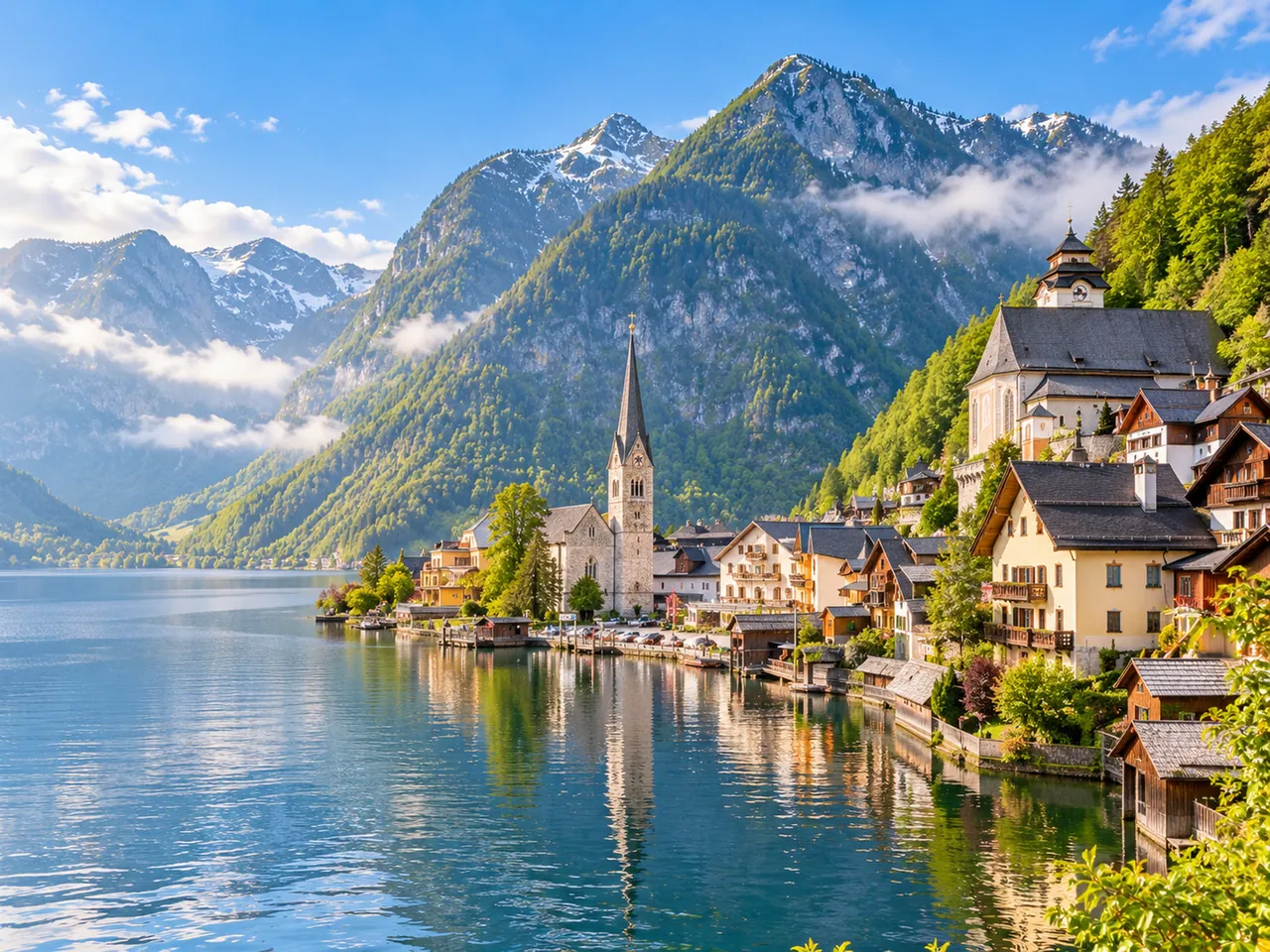
Is February a good time?
February averages 45°F afternoons, with about 9 rain days. Later February is typically warmer.
Historical Oberösterreich regional averages, not a forecast or a measure of queues. Overnight demand compares average stays per day. Covers Hallstatt, Linz and Salzkammergut (part); conditions vary within the region.
What matters most?
Weather 50% · Crowds 30% · Cost 20%
#9 of 12 months here · Balanced mix
Overall combines weather, overnight demand and cost. It does not include sea temperature.
Plan your February
Afternoons around 45°F (7°C): a warm coat; nights around 29°F (−2°C): a winter coat, hat and gloves. Bring rain gear: about 9 days with at least 1 mm of rain. About 10 hours of daylight.
The sun rises about 07:13 and sets about 17:24 (local time, mid-month). Mornings start around 29°F (−2°C); afternoons reach about 45°F (7°C). Expect rain on about 9 days in a typical February.
Early, middle or late?
Late February is typically warmer. The afternoon high averages 42°F on the 1st, versus 48°F on the 28th. Historical wet-day frequency falls from 36% to 25% between those dates.
42°F
Typical afternoon high
36% historical wet-day frequency
45°F
Typical afternoon high
32% historical wet-day frequency
48°F
Typical afternoon high
25% historical wet-day frequency
Historical daily averages from 2011–2025, smoothed over two weeks. A seasonal pattern, not a forecast. This does not establish which week has the lowest prices or fewest visitors.
Weather shows historical patterns, not a forecast. Holidays and events use the dates shown for 2027.
| Mon | Tue | Wed | Thu | Fri | Sat | Sun |
|---|---|---|---|---|---|---|
| 142° | 242° | 342° | 442° | 542° | 642° | 742° |
| 843° | 943° | 1043° | 1144° | 1244° | 1344° | 1445° |
| 1545° | 1646° | 1746° | 1846° | 1946° | 2047° | 2147° |
| 2247° | 2347° | 2448° | 2548° | 2648° | 2748° | 2848° |
Afternoon high rain likely (25%+) local school holidays public holiday event
Afternoons warm from about 42°F (6°C) in the first week to 48°F (9°C) in the last. The chance of a wet day runs 25–37%. Local schools are out 15–20 February 2027.
Schools here are off 15–20 February 2027 (semester holidays). Elsewhere in February 2027, the share of people living where schools are out on a typical day: France 42%, Netherlands 46%, Belgium 25%, Czechia 18%. (School holidays: OpenHolidays, ODbL.)
Visitor season
Moderate season. February averages 50% of August's overnight stays per day. More overnight stays than January.
Overnight stays across Oberösterreich do not measure queues, day visitors or congestion at individual sights. For its size, typical for Europe this month.
Hotel price season
Well below usual. Estimated from national hotel prices and local visitor demand; no measured regional room rate is available.
Fewer overnight stays do not automatically mean cheaper rooms. Check actual quotes for your trip.
Year-to-year variation
In the 15 years from 2011 to 2025, the month's afternoons averaged between 34°F (1°C) and 52°F (11°C); in 6 of them they were within 3°F (1.5°C) of the typical 45°F (7°C). Rain days ranged from 3 to 17; half the years had 7–12.
Rain days in each February
| Year | Afternoon high | Rain days |
|---|---|---|
| 2011 | 43°F | 3 |
| 2012 | 34°F | 11 |
| 2013 | 38°F | 14 |
| 2014 | 49°F | 7 |
| 2015 | 43°F | 5 |
| 2016 | 49°F | 12 |
| 2017 | 47°F | 10 |
| 2018 | 37°F | 8 |
| 2019 | 48°F | 7 |
| 2020 | 49°F | 17 |
| 2021 | 48°F | 10 |
| 2022 | 46°F | 13 |
| 2023 | 46°F | 8 |
| 2024 | 52°F | 9 |
| 2025 | 45°F | 3 |
Checked against 28 local weather stations. How we check
Compare dates
| Typical conditions | Jan | Feb | Mar |
|---|---|---|---|
| Afternoons | 41°F | 45°F | 53°F |
| Rain days | 13 | 9 | 10 |
| Overnight demand | 43% | 50% | 46% |
January: Cooler afternoons and more rain days than February. Less overnight demand. January guide →
March: Warmer afternoons than February. March guide →
Overnight demand measures accommodation stays, not queues.
Yellow marks the top three months on the Balanced mix. February stays as your reference.
March to April have a Weather score at least 1.0 point higher than February, without a substantially busier visitor season.
Your comparison
Overnight stays are 43% of the busiest month.
National hotel prices and local visitor demand suggest well below usual. No measured regional room rate is available.
Read the January guide →| Typical conditions | February | January |
|---|---|---|
| Afternoons | 45°F | 41°F |
| Nights | 29°F | 28°F |
| Rain days | 9 | 13 |
| Visitor season | Moderate season | Moderate season |
| Overall / 10 | 6.5 | 6.0 |
| Month rank | #9 | #12 |
| Month | Overall | Rank | High | Low | Rain days | Weather | Visitor season |
|---|---|---|---|---|---|---|---|
| January | 6.0 | #12 | 41°F | 28°F | 13 | 4.0 | Moderate season |
| February | 6.5 | #9 | 45°F | 29°F | 9 | 4.9 | Moderate season |
| March | 7.2 | #4 | 53°F | 33°F | 10 | 6.1 | Moderate season |
| April | 7.5 | #1 | 61°F | 40°F | 9 | 7.3 | Moderate season |
| May | 7.2 | #3 | 67°F | 47°F | 12 | 7.6 | Busy season |
| June | 7.0 | #6 | 76°F | 56°F | 11 | 8.3 | Busy season |
| July | 6.6 | #8 | 79°F | 58°F | 11 | 8.2 | Peak season |
| August | 6.3 | #10 | 78°F | 58°F | 10 | 8.2 | Peak season |
| September | 7.4 | #2 | 70°F | 51°F | 9 | 8.3 | Busy season |
| October | 7.1 | #5 | 61°F | 43°F | 9 | 7.0 | Moderate season |
| November | 6.7 | #7 | 49°F | 35°F | 8 | 5.3 | Moderate season |
| December | 6.2 | #11 | 43°F | 30°F | 14 | 4.3 | Moderate season |
Near here
Nearby regions, nearest first. Distances are centre to centre, as the crow flies; they are not road distances or journey times.
 SalzburgAustria · about 70 miles
Balanced Overall 4.5 · Fair weather, 44°F (7°C) · Peak season · Cost pricey
 Lower BavariaGermany · about 70 miles
Balanced Overall 6.2 · Fair weather, 44°F (7°C) · Moderate season · Cost pricey
 Munich & Upper BavariaGermany · about 100 miles
Balanced Overall 6.3 · Fair weather, 45°F (7°C) · Moderate season · Cost pricey
 TyrolInnsbruck · Austria · about 130 miles
Balanced Overall 4.5 · Fair weather, 43°F (6°C) · Peak season · Cost pricey
 South Tyrol & the DolomitesItaly · about 160 miles
Balanced Overall 5.9 · Good weather, 47°F (8°C) · Busy season · Cost pricey
Elsewhere in Europe
Upper Austria & Hallstatt's weather ranks 49 of 117 countryside regions this month. These countryside regions outside Austria have clearly better weather on your dates, nearest first, each compared with Upper Austria & Hallstatt.
 PiedmontItaly · about 360 miles
Good weather (5.9): 6°F warmer afternoons, 2 fewer rain days
 UmbriaItaly · about 360 miles
Good weather (5.9): 9°F warmer afternoons, quieter for its season (low season)
 Tirana & central Albaniaabout 570 miles
Good weather (6.2): 12°F warmer afternoons, quieter for its season (low season), cheaper
 Plovdiv & south-central Bulgariaabout 690 miles
Good weather (6.0): 5°F warmer afternoons, 3 fewer rain days, cheaper
 Castile and LeónSpain · about 1010 miles
Good weather (5.9): 7°F warmer afternoons, cheaper
It's moderate season, 50% of the busiest month and 19% below its average month. That means about 18,000 overnight visitors on a typical February night across the region, 64% of them from Austria itself. Rentals booked through Airbnb, Booking, Expedia and Tripadvisor add up to 2,100 more: 12 for every 100 counted above. Some are the same properties counted twice.
| Climate suitability (HCI:Urban, 0–100) | 59 |
| How our weather was checked | 28 open weather stations in this region, January and July: afternoon highs typically within 2°F (0.8°C), night lows within 1°F (0.4°C). |
| Tourist nights per 1,000 residents per day | 12 |
| Busiest month here | August · 23 |
| Visitors as share of people present | 1.1% |
| Rank among Europe's regions this month | 71st percentile |
| Domestic share of nights | 64% |
| Platform rental nights per 100 counted nights | 12 |
| Visitor share if every platform night were extra | 1.3% |
| National hotel-price season | Austria historical 2024–2025 index: About usual (0% vs its average month). Not a local room quote. |
| Population used | 1.5 million |
| Statistical region | AT31 · Oberösterreich |
Crowds: Eurostat nights spent at tourist accommodation, by month and NUTS 2 region, 2024–2025 average. Overnight visitors per night is the month's nights divided by its days; the per-1,000 figure is Eurostat's, against each year's population. Platform rentals: Eurostat nights booked via Airbnb, Booking, Expedia and Tripadvisor, 2024–2025 average, shown separately because some properties are in both counts. Weather: Holiday Climate Index computed from ERA5 reanalysis with daily highs, night lows and rain days corrected from open national weather-service station records, 2011–2025, population-weighted to the region; day-by-day figures are the same data averaged by date. Heat and rain odds are counted across those years. Sunrise and sunset: NOAA solar equations, local time. Prices: Eurostat price level index and HICP, national. Full method · this region's data.